NVDA Q1 FY27 Earnings: $81.6B Revenue Smashes Estimates, $91B Q2 Guidance Signals Accelerating AI Demand
wealthvista.top Editorial · May 21, 2026 · 9 min read
Executive Summary
NVIDIA posted $81.6 billion in revenue for Q1 FY27, clearing Wall Street’s $78.5–78.8 billion consensus by roughly $3 billion. Non-GAAP EPS came in at $1.87 versus the $1.77 estimate, a 5.6% beat that extends NVIDIA’s streak. Data Center hit a new record at $75.2 billion, up 92% year-over-year, driven by Blackwell GPU deployments across hyperscalers. Management guided Q2 FY27 revenue to $91 billion — roughly $10 billion above where analysts had positioned their models. The stock slipped about 1.5% in after-hours trading, which has been the post-earnings pattern for the past two years. The key takeaway: AI infrastructure demand is not decelerating. If anything, the guide выше confirms the buildout has further to run.
1. Quarter Highlights vs. Expectations
NVIDIA reported Q1 FY27 (quarter ended April 26, 2026) results that again demonstrated the extraordinary momentum of AI-related demand across its customer base.
Revenue Performance
| Metric | Q1 FY27 Actual | Q4 FY26 | Q1 FY26 | Consensus Estimate |
|---|---|---|---|---|
| Revenue | $81.6B | $68.1B | $44.1B | ~$78.5–78.8B |
| Non-GAAP EPS | $1.87 | $1.59 | $0.78 | $1.77 |
| GAAP EPS | $2.39 | $1.76 | $0.76 | — |
| Non-GAAP Gross Margin | 75.0% | 75.1% | 60.8% | ~74.5% |
| Data Center Revenue | $75.2B | $62.3B | $39.1B | $73.1B |
| Edge Computing Revenue | $6.4B | $5.8B | $4.9B | — |
Revenue of $81.6 billion cleared consensus by roughly $3 billion, good for an 85% year-over-year increase and a 20% sequential gain. Data Center drove the beat — that segment now represents over 92% of total revenue. Non-GAAP EPS of $1.87 beat the $1.77 consensus by 5.6%. GAAP EPS of $2.39 was distorted by a large gain on equity securities, which widened the GAAP/non-GAAP gap more than typical.
Gross margin held at 75.0% (non-GAAP), roughly flat versus Q4 FY26’s 75.1%. That’s worth noting because Blackwell carries higher component costs initially, and it’s now a growing share of the mix. The margin tells you NVIDIA’s pricing power is intact even at this scale of ramp. Operating expenses of $7.4 billion (non-GAAP) grew 12% sequentially while revenue grew 20% — operating leverage doing its job.
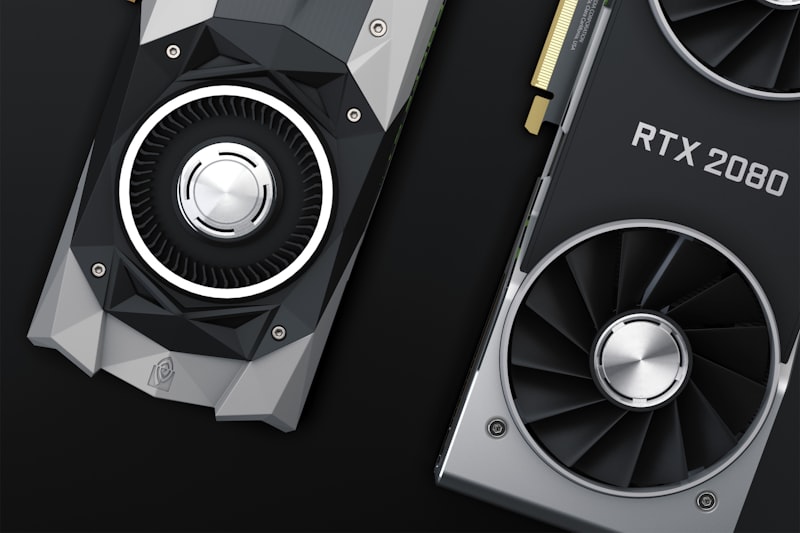 NVIDIA GPUs are at the center of the AI infrastructure buildout — Image source: Unsplash (free for commercial use)
Margin Performance
Non-GAAP gross margins of 75.0% came in slightly above the 74.5% Street expectation and essentially flat versus Q4. The stability here is notable: Blackwell, which carries higher raw material costs, is taking up an increasing share of total mix, yet margins didn’t compress. Operating expenses of $7.4 billion (non-GAAP) grew 12% sequentially while revenue grew 20%, which is the kind of leverage you want to see at this stage of a hypergrowth cycle. GAAP operating income of $53.5 billion was up 147% year-over-year.
2. Business Segment Analysis
NVIDIA introduced a new reporting framework starting this quarter, splitting the business into Data Center and Edge Computing platforms.
Data Center — The Growth Engine
Data Center revenue reached a record $75.2 billion, up 92% year-over-year and 21% sequentially. Under the prior segmentation, Data Center compute revenue was $60.4 billion (up 77% YoY) and Data Center networking revenue was $14.8 billion (up 199% YoY). The networking figure is particularly striking — the InfiniBand and Ethernet switch businesses are accelerating at a pace that reflects the bandwidth demands of AI training clusters, not just GPU orders.
The transition to Blackwell architecture is in full ramp, with Blackwell Ultra deployments accelerating. Management cited “extraordinary speed” in the buildout of AI factories, describing it as the largest infrastructure expansion in human history. Partnerships with Google Cloud, Marvell (NVLink Fusion), Corning, Coherent, and Lumentum signal a push into silicon photonics and advanced optics to support the bandwidth requirements of future AI fabrics.
The new Data Center sub-segment breakdown separates Hyperscale (public clouds and largest consumer internet companies) from ACIE (AI Clouds, Industrial, and Enterprise) — the latter representing NVIDIA’s growth opportunity in more diverse, purpose-built AI factories across industries and sovereign governments.
Edge Computing — Gaming, PC, Automotive, Robotics
Edge Computing revenue was $6.4 billion, up 10% sequentially and 29% year-over-year. This bucket covers gaming GPUs, PC workstations, AI-RAN base stations, robotics, and automotive. Gaming ran around $3.5–3.7 billion, a seasonal drop from the holiday quarter typical of the consumer GPU cycle. Automotive came in at $604 million.
The more durable Edge story is around AI PCs and robotics. NVIDIA called out optimizations for local agentic models — Gemma 4, Qwen, Mistral — running on RTX hardware. On the automotive side, DRIVE Hyperion has new level-4-ready programs with BYD, Geely, Hyundai/Kia, and Uber. Physical AI — robots, autonomous vehicles, industrial automation — is where Edge diverges from the GPU replacement cycle and enters a longer-duration growth vector. It’s not a large revenue contributor yet, but the trajectory matters for the post-B Blackwell story.
3. Management Guidance vs. Street Expectations
For Q2 FY27, NVIDIA guided revenue of $91 billion (±2%). The Street had been at roughly $86–87 billion, so the guide came in about $10 billion above where models were sitting. That’s a material revision. Non-GAAP gross margin is expected at 75.0% (±50 bps), implying no compression as Blackwell continues its ramp. Non-GAAP operating expenses are seen at $8.3 billion, reflecting continued R&D investment in Vera Rubin and future architectures.
The $91 billion Q2 guide implies roughly 74% year-over-year growth — extraordinary for a company this size. Notably, management excluded any Data Center compute revenue from China in the outlook, reflecting ongoing US export restrictions. That conservatism is worth noting when you’re modeling the quarter.
The full-year tax rate is expected in the 16–18% range. On capital return: NVIDIA raised its quarterly dividend from $0.01 to $0.25 per share — a 25x increase — and the board approved an additional $80 billion share repurchase authorization on May 18. The company returned $20 billion to shareholders in Q1 alone. At this cash generation rate, that’s sustainable.
4. Balance Sheet and Cash Flow Health
NVIDIA’s balance sheet is about as clean as it gets at this scale:
Cash and short-term investments are well above $30 billion. Operating cash flow is running at a level that supports $20 billion quarterly returns to shareholders while also funding elevated R&D for next-gen silicon. The new $80 billion buyback authorization, combined with the 25x dividend hike, signals management is leaning into capital return rather than hoarding cash. NVIDIA is essentially debt-free structurally.
What this means practically: NVIDIA has the financial flexibility to weather a demand slowdown, continue returning capital, and keep investing in the next architecture simultaneously. That’s a rare combination at $80 billion-plus quarterly revenue.
5. Valuation Assessment
Here’s how to think about the multiple. Non-GAAP EPS for Q1 was $1.87, which annualizes to roughly $7.48. At around $223 per share, that’s roughly 30x forward earnings. But Q2 guidance of $91 billion implies an even higher quarterly EPS run rate — north of $2.00 on a non-GAAP basis — which would put the forward multiple closer to 25–27x on an annualized basis. EV/EBITDA sits in the mid-teens given the $2 trillion market cap and EBITDA well above $200 billion annually. The P/S on Q1 annualization is around 7x, which is expensive relative to history but reasonable given the growth curve.
The bull case depends on whether the AI infrastructure buildout sustains multi-year duration. Management mentioned $1 trillion in Blackwell and Vera Rubin processor revenue across 2026 and 2027 — that alone would imply $500+ billion in annual revenue by 2027 if the split is roughly even. That’s not consensus. It’s also not impossible given the Q2 guide.
6. Competitive Positioning and Catalysts
NVIDIA’s competitive moat has arguably widened during this AI cycle. NVLink and NVSwitch have no credible rival at GPU-to-GPU interconnect scale — any multi-GPU AI training system is effectively NVIDIA-native by design. The CUDA installed base is so large that switching costs are structural, not preference. The networking number is underappreciated: InfiniBand and Ethernet switches grew 199% year-over-year, meaning NVIDIA is winning the AI fabric battle, not just the GPU battle. And the software stack is moving upmarket — Dynamo, NemoClaw, Agent Toolkit — locking in software dependencies alongside hardware.
The Vera Rubin ramp is the next catalyst. Targeted for second-half calendar 2026, it’s the successor architecture to Blackwell. Early data center qualification is already underway. Agentic AI enterprise adoption and sovereign AI deals are broadening the customer base beyond the hyperscaler five. Physical AI — robotics, autonomous vehicles, AI-RAN — adds a diversification layer that could become meaningful over the next few years.
7. Key Risks
1. China export restrictions and revenue concentration. Management explicitly excluded China Data Center compute revenue from Q2 guidance, which isn’t new but it’s a real headwind. The hyperscaler concentration — top five cloud providers account for roughly 63% of global cloud infrastructure — means a capex pullback from any one of them moves the needle.
2. Circular deal sustainability. A portion of AI infrastructure demand flows through arrangements where hyperscalers, model developers, and cloud providers invest in each other in ways that support GPU orders. Management emphasizes rising utilization rates and genuine end-user demand, but this is worth monitoring. If AI model training spend decelerates, the inventory correction would be sharp.
3. Architecture execution and pricing pressure. As Blackwell Ultra and Vera Rubin ramp, maintaining the 75% gross margin depends on yields, supply continuity, and pricing. Custom silicon from the hyperscalers — Amazon’s Trainium, Google’s TPU, Meta’s MTIA — isn’t replacing NVIDIA at the high end yet, but it’s a credible long-term threat to attachment rates and pricing power in certain workloads.
8. Investment Conclusion
BUY. The Q1 FY27 numbers confirm the AI infrastructure buildout has not peaked. Revenue of $81.6 billion beat by $3 billion. The Q2 guide of $91 billion came in $10 billion above Street expectations. Non-GAAP EPS of $1.87 beat by 5.6%. Gross margins held at 75.0%. Data Center grew 92% year-over-year. The dividend went up 25x and the board authorized another $80 billion in buybacks. The stock dropped 1.5% in after-hours — the same pattern that’s been a buying opportunity for two years running.
The bull case is straightforward: AI factory buildout is a multi-year cycle, Vera Rubin extends the Blackwell moat, and agentic AI inference demand keeps utilization rates elevated on installed clusters. A company on pace for $350+ billion in annual revenue with 75% gross margins is worth more than the current multiple implies.
The bear case is equally straightforward: export restrictions tighten, AI capex cycles turn, custom silicon erodes GPU attachment, or a $2 trillion market cap simply becomes too rich for institutional flows to keep accumulating. Any one of those becomes a problem.
At roughly $223 per share and a forward P/E in the high-20s on a business growing 70–80%, NVIDIA is the highest-quality large-cap growth opportunity in semiconductors today. The burden of proof is on the bear, not the bull.
Sources: NVIDIA Official Press Release — Q1 FY27 · Yahoo Finance — Analyst Estimates · The Motley Fool — Earnings Preview